What is AggScatVIR?
AggScatVIR stands for AGGregate SCATtering at Visual and InfraRed wavelengths. This project aims to provide the optical properties of complex-shaped dust particles that can be used to interpret scattered light observations of circumstellar disks (such as protoplanetary disks and debris disks) at visible and near-infrared wavelengths. This allows us to interpret disk observations without relying on the Mie theory. To this end, we have conducted more than 10,000 light-scattering simulations using either the T-matrix method or discrete dipole approximation for various particle morphologies. Currently, the database consists of the scattering matrix and opacity of dust particles studied in Tazaki & Dominik (2022) and Tazaki, Ginski, and Dominik (2023).
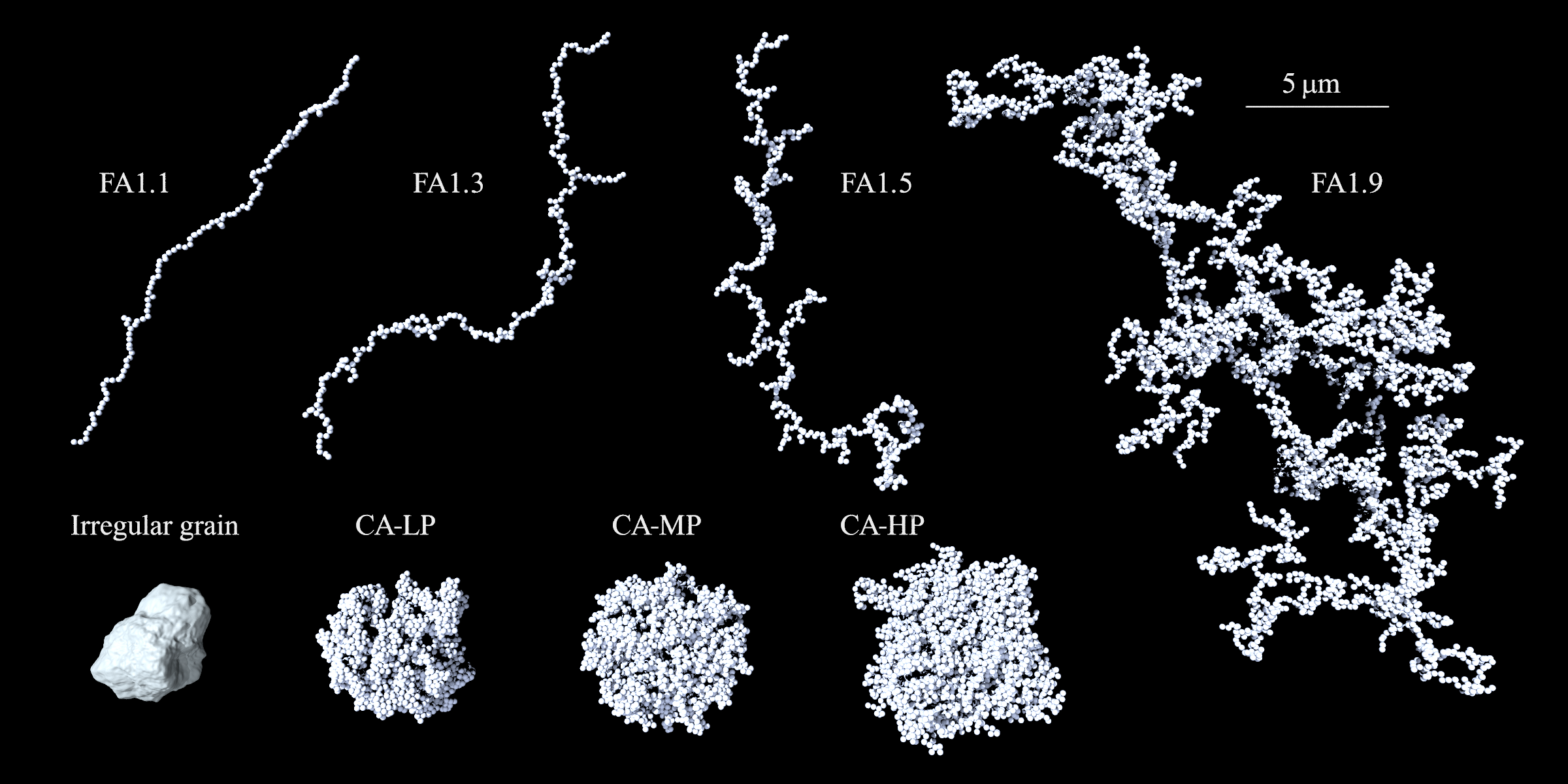
Highlighted features
Based on rigorous light-scattering solvers: We used rigorous numerical techniques to calculate the optical properties of complex-shaped particles, such as the T-matrix method (used for aggregates) and discrete dipole approximation (used for irregular grains). This feature allows us to study the effect of particle shape on the light scattering properties precisely.
An extensive parameter-space coverage: We cover a wide range of parameter space, such as aggregate radius, monomer radius, composition, porosity, and fractal dimension. The database contains 360 different dust models; 20 irregular grain models (10 grain radii; 2 compositions), 126 different compact aggregate models (3 aggregation models; 2 compositions; 3 monomer radii; on average 7 aggregate radii), and 214 fractal aggregate models (4 different fractal dimensions, 2 compositions, 5 monomer radii; on average 5.35 aggregate radii). This feature allows us to study a detailed parameter dependence of the light scattering properties.
Full compatibility with RADMC-3D v2.0: One key application of
AggScatVIRis to model observed (polarized) scattered light images of protoplanetary disks and debris disks. For this purpose, each file provided in this database has a data structure that is directly readable by a public radiative transfer code RADMC-3D v2.0. This feature allows us to compare actual observed images to a model image that fully takes into account the light scattering properties of complex particles.
Assumptions and Limitations
Since we adopt exact numerical techniques for solving the optical properties, the limitation comes from simulation setups.
Randomly orientated particles: Given that each dust particle is no longer symmetrical in shape, we must assume an orientation of the particle relative to the direction of the incident and scattered lights. We assume that the particles are randomly orientated, and their optical properties are averaged over all possible orientations with equal probability. In other words, we do not consider the case where non-spherical particles become aligned. This assumption results in only six elements of the scattering matrix being independent.
Monomers are homogeneous spheres with a single size: Dust aggregates consist of numerous small particles referred to as monomers. The optical properties of the aggregates contained in this database are all constructed from monodisperse monomers with a homogeneous composition for computational convenience.
Limited wavelength coverage: As the package name suggests, this database contains the optical properties of visible and near-infrared wavelengths (ranging from \(0.554~\mu\mathrm{m}\) to \(3.780~\mu\mathrm{m}\)). Consequently, if you are seeking the optical properties at a wavelength outside this range, the database will not be useful.
How to cite?
If you would like to publish results generated by using this package, please cite the following papers.
Acknowledgement
We thank Daniel Mackowski and Maxim A. Yurkin for making the MSTM and ADDA codes publicly available, respectively. We also thank Bruce Draine for the availability of particle position data of BA, BAM1, and BAM2; N. Moteki for the availability of the aggregate_gen code; Yasuhiko Okada for providing us a generation code of BCCA.